

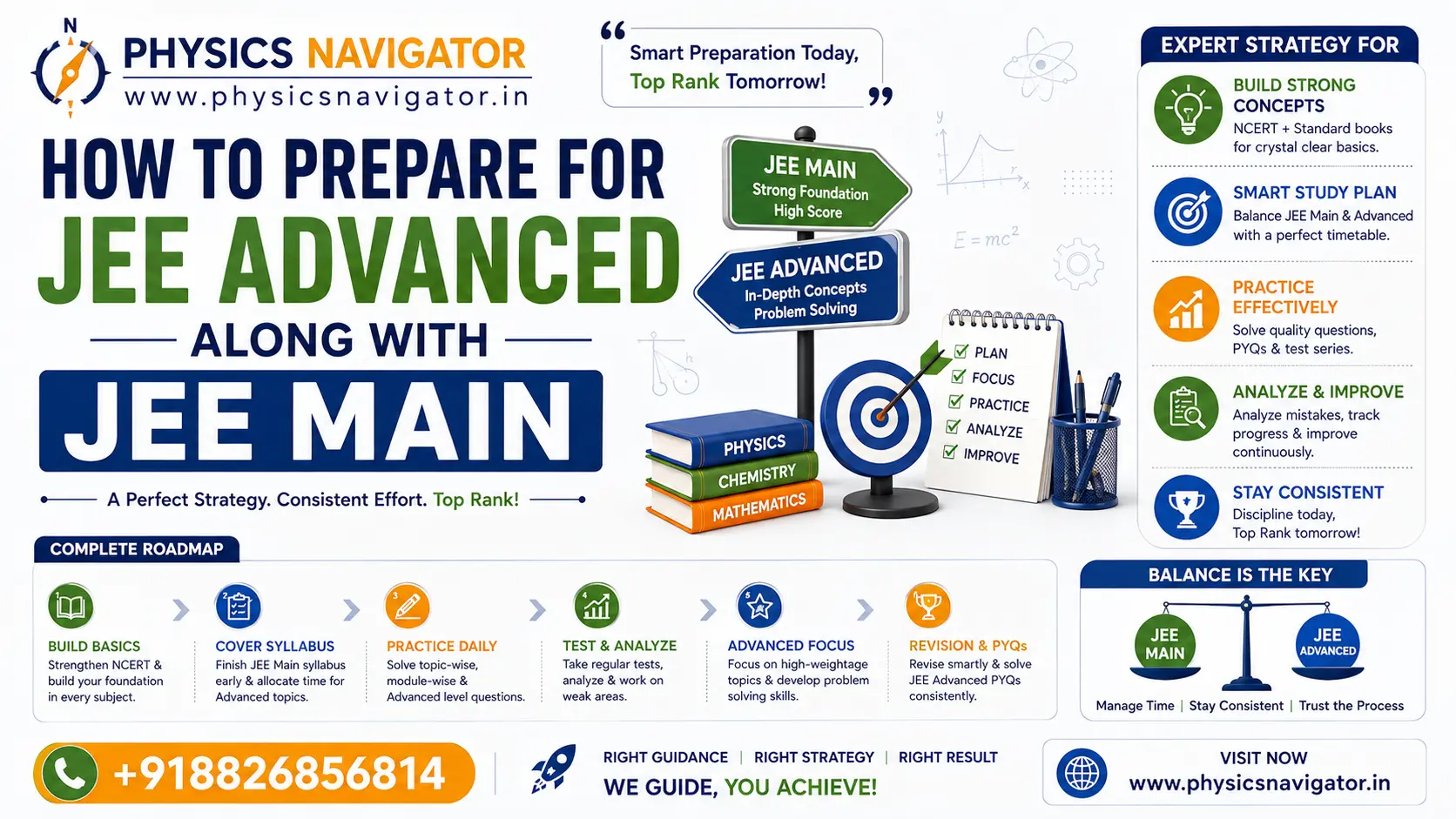
Key Takeaways
- The two exams share most of their syllabus, so you study each chapter once and then practice it at two different difficulty levels — not learn it twice.
- JEE Main rewards speed and clean accuracy on moderate problems. JEE Advanced rewards long reasoning chains on unfamiliar, multi-concept problems.
- A roughly 70/30 split — concepts plus Main-level practice, then Advanced-level problems — works for most students through the main preparation year.
- Dropping Main-level timed practice to focus only on hard problems is the single most common way students damage their Main score.
- The weeks between the two exams are for Advanced-pattern mocks and multi-concept practice, never for starting new chapters.
- Advanced's marking scheme, especially partial marking on multiple-correct questions, needs deliberate practice — it changes which questions are worth attempting.
In This Guide
- Why This Question Comes Up Every Year
- What Actually Differs Between the Two Exams
- The Syllabus Overlap, and Where It Ends
- The Core Principle: Learn Once, Practice Twice
- How to Split Your Time
- Physics: Where the Gap Between Main and Advanced Is Widest
- Chemistry and Mathematics: A Different Balance
- A Realistic Year-Long Plan
- The Weeks Between Main and Advanced
- Reading the Advanced Marking Scheme Properly
- Choosing Resources for Dual Preparation
- What a Week Actually Looks Like
- Adjusting for Your Situation
- Mistakes That Cost Students Both Exams
- Where a Teacher Actually Helps
- Frequently Asked Questions
- Conclusion
Why This Question Comes Up Every Year
Almost every serious JEE aspirant eventually asks some version of the same thing: should I prepare for JEE Main and JEE Advanced separately, or can I do both at once? The question sounds like a scheduling problem. It isn't. It's really a question about what each exam is actually testing, and whether those two things can be built at the same time.
The short answer is yes, and in practice almost everyone who clears Advanced did prepare for both simultaneously. There isn't enough time in a preparation year to treat them as two separate courses, and there's no need to, because the syllabus overlap is genuinely enormous. What trips students up isn't the volume of content. It's the assumption that being good at one automatically means being good at the other.
A student who has drilled hundreds of JEE Main problems can walk into an Advanced paper and find that the questions look almost unrecognizable, not because the physics is unfamiliar but because the reasoning chain is three times longer and the setup is deliberately unfamiliar. Equally, a student who spends a year on brutal Advanced-level problems can lose real marks in Main to careless errors and poor pacing on questions that were well within reach. Both failures come from the same root cause: treating the two exams as one thing.
This guide is about doing it properly. Not studying twice as much, but studying once and practicing deliberately in two registers.
What Actually Differs Between the Two Exams
Before building a plan, it's worth being precise about the difference, because vague statements like "Advanced is harder" don't tell you what to actually change in your routine.
JEE Main: Speed, Accuracy, Coverage
JEE Main questions are largely single-concept or lightly combined. The mathematics involved is usually direct. A well-prepared student generally recognizes the required approach within a few seconds and spends the remaining time executing cleanly. The exam's real difficulty comes from volume and pace: a large number of questions across three subjects in a fixed window, with negative marking punishing careless attempts.
What this rewards: reliable formula recall, fast recognition of standard problem types, arithmetic accuracy under pressure, and the discipline to move on from a question that's eating time.
JEE Advanced: Depth, Reasoning, Unfamiliarity
Advanced questions typically combine multiple concepts and are often deliberately framed in situations a student hasn't seen before. A single problem might require setting up a force balance, recognizing an energy conservation shortcut, and then handling a non-trivial integration. The question formats add another layer: multiple correct options, integer or numerical answers, and matching-type questions where partial credit rules change the risk calculus entirely.
What this rewards: genuine conceptual depth, comfort sitting with an unfamiliar problem for several minutes without panicking, the ability to break a complex setup into recognizable pieces, and mathematical fluency strong enough that the algebra doesn't become the bottleneck.
The Syllabus Overlap, and Where It Ends
The overlap between the two syllabi is very high, which is the entire reason dual preparation is feasible. Both are built on the NCERT Class 11 and 12 foundation across Physics, Chemistry and Mathematics, and the large majority of topics appear in both.
Where they diverge is mainly in depth rather than in topic lists. A few areas historically receive noticeably deeper treatment in Advanced:
- Rotational mechanics. Main tests standard moment-of-inertia and rolling problems. Advanced pushes into combined translation-rotation systems, constraint relations, and setups where the axis itself is accelerating.
- Electrodynamics. Both cover the same laws, but Advanced regularly asks for field calculations in non-standard geometries and circuit analysis that requires genuine reasoning rather than formula substitution.
- Thermodynamics. Advanced tends to combine thermodynamic processes with kinetic theory and sometimes mechanics in a single problem.
- Calculus-based problem solving. Advanced expects comfort applying differentiation and integration directly inside physics problems, not as a separate mathematics exercise.
The important implication: you are not learning extra chapters for Advanced. You are learning the same chapters to a greater depth. That's why a "finish Main first, then start Advanced" approach wastes time — it implies a second pass through content that should have been learned properly the first time.
Do check the official syllabus documents for your specific exam year rather than relying on a general description, since both NTA and the conducting IIT publish their own syllabus and either can revise details between cycles.
The Core Principle: Learn Once, Practice Twice
The whole strategy reduces to a single idea. Study each chapter once, thoroughly, aiming for the depth Advanced requires. Then practice that chapter at two levels: a Main-level set focused on speed and accuracy, and an Advanced-level set focused on multi-concept reasoning.
This sequence matters. Learning a chapter to Main-level depth and returning months later to deepen it for Advanced means re-learning, because the shallow version doesn't provide the scaffolding the harder problems need. Learning it to Advanced depth first, then practicing Main-level problems, is far more efficient — the easier problems become almost trivial and serve as speed drills rather than learning exercises.
Concretely, a chapter cycle looks something like this:
- Concept building. NCERT first for the foundation, then a standard reference text for depth. Understand derivations, not just results. Ask what each formula assumes and where it stops applying.
- Main-level practice. A solid set of standard problems, done under mild time pressure. The goal here is fluency and accuracy, not challenge.
- Advanced-level practice. Multi-concept problems from a harder problem book, plus previous year Advanced questions on that chapter. Expect to be slow. That's the point.
- Error review. Log what went wrong and categorize it: conceptual gap, calculation slip, misread setup, or simply an approach you hadn't seen before. The fourth category is normal in Advanced practice and shrinks with exposure.
One chapter handled this way is worth considerably more than three chapters skimmed at Main level with a vague intention to "come back for Advanced later." That intention rarely survives contact with a real study calendar.
How to Split Your Time
A reasonable default for most students through the main preparation year is roughly 70% on concept building and Main-level practice, 30% on Advanced-level problems. That ratio isn't arbitrary. Main is the qualifying gate for Advanced, and a weak Main score makes the Advanced question moot. But 30% is enough sustained exposure that Advanced-style thinking develops steadily rather than being crammed in at the end.
Two adjustments worth making:
- Weight the 30% toward high-yield Advanced chapters. Mechanics, Electrodynamics and Thermodynamics reward Advanced-level practice more than, say, a lighter chapter that Advanced tests only superficially. Spreading the 30% evenly across all chapters dilutes it.
- Shift the ratio as the exams approach. In the final months before Main, tilt toward Main-level timed practice. In the gap between Main and Advanced, flip almost entirely to Advanced.
| Phase | Concept + Main-level | Advanced-level | Primary Goal |
|---|---|---|---|
| Early preparation year | 70% | 30% | Build depth chapter by chapter |
| Mid-year | 65% | 35% | Consolidate; start full-syllabus mocks |
| Final 8 weeks before Main | 85% | 15% | Speed, accuracy, Main-pattern mocks |
| Between Main and Advanced | 15% | 85% | Advanced-pattern mocks and multi-concept practice |
Treat these as starting points to adjust against your own mock results, not fixed rules. A student whose Main mocks are consistently strong can afford to push the Advanced share up earlier. A student struggling with careless errors in Main-level practice should hold the ratio conservative until that stabilizes.
Physics: Where the Gap Between Main and Advanced Is Widest
Across the three subjects, Physics is where the difference between Main-level and Advanced-level preparation is most pronounced. Chemistry rewards recall and reaction familiarity heavily enough that the gap narrows. Mathematics is demanding in both. But Physics at the Advanced level asks for a kind of model-building that Main rarely requires.
What Advanced Physics Actually Demands
A typical Advanced physics problem gives you a situation, not a question type. You have to decide what's actually happening physically before any formula becomes relevant. That means:
- Drawing the setup properly. A clean free body diagram or circuit redraw solves a surprising share of Advanced problems before any algebra starts.
- Choosing the efficient route. Many problems are solvable by brute force and by a conservation argument. Recognizing the second saves minutes that matter.
- Handling constraints. Pulleys, rolling conditions, and connected bodies require relating variables before solving, a step Main problems often hand you directly.
- Sanity-checking results. Does the limit case make sense? Does the answer have correct dimensions? Advanced rewards this habit because it catches errors mid-problem.
Building That Skill Deliberately
Conceptual depth first: work through derivations rather than memorizing endpoints, since Advanced problems frequently sit in the reasoning behind a formula rather than the formula itself. Then practice with deliberately hard problem sets, and crucially, sit with each problem for a genuine stretch — ten to fifteen minutes — before looking at a solution. The productive struggle is where the skill is actually built; reading solutions quickly builds recognition, not capability.
Previous year Advanced papers deserve special treatment here. They're the most accurate available signal of how the exam frames problems. Work them chapter-wise while studying a topic, then as full papers under time pressure closer to the exam.
The students who do well in Advanced Physics are usually not the ones who solved the most problems. They're the ones who spent longer on each hard problem before giving up.
Chemistry and Mathematics: A Different Balance
The dual-preparation strategy shifts slightly by subject, and treating all three identically wastes effort.
Chemistry
Physical Chemistry behaves much like Physics — Advanced pushes into multi-step numerical problems and combined concepts, so the same learn-once-practice-twice cycle applies cleanly. Inorganic Chemistry is heavily recall-based in both exams, with Advanced testing exceptions and finer detail; the efficient approach is thorough NCERT coverage plus systematic revision rather than harder problem solving. Organic Chemistry sits in between: Main tests standard reactions and mechanisms, while Advanced regularly asks for multi-step synthesis reasoning and stereochemical detail that rewards genuine mechanism understanding over memorized reaction lists.
The practical consequence is that Chemistry's Advanced-level extra work is concentrated in Physical and Organic, while Inorganic mostly needs breadth and repetition rather than difficulty escalation.
Mathematics
Mathematics is demanding in both exams, but Advanced problems more often require choosing a non-obvious approach rather than executing a known one. Calculus, coordinate geometry and algebra all reward the habit of asking "what structure is this problem actually built on" before starting.
There's also a compounding benefit worth naming: strong mathematical fluency directly improves Advanced Physics performance, because it removes the algebra bottleneck from long physics problems. Time spent on mathematics is rarely wasted for a dual-preparation student.
A Realistic Year-Long Plan
A workable structure for a student with roughly a year of focused preparation ahead. Adjust the boundaries to your own calendar rather than following dates rigidly.
Phase 1 — Foundation (roughly the first five to six months)
Work chapter by chapter through the syllabus using the four-step cycle described earlier. Maintain the 70/30 split. Build the error log habit from week one, because its value comes entirely from accumulation. Take a chapter-wise test after each major topic to confirm the concept actually landed before moving on. Resist the pull to rush coverage; a syllabus finished shallowly needs to be redone.
Phase 2 — Consolidation (roughly the next three to four months)
Begin full-syllabus mock tests, alternating between Main pattern and Advanced pattern. Start tracking performance by chapter rather than only by total score, since an aggregate hides exactly the information you need. Return to weak chapters identified through mocks and re-run the practice cycle on them. Increase the Advanced share modestly as accuracy stabilizes.
Phase 3 — Main Focus (final six to eight weeks before Main)
Shift decisively toward Main-pattern timed practice. This is where speed and clean execution get locked in. Full-length Main mocks at least twice weekly, each followed by proper analysis. Keep a small amount of Advanced practice running — perhaps two sessions a week — purely so the harder reasoning doesn't go cold, but the priority is unambiguous.
Phase 4 — Advanced Sprint (the weeks between the two exams)
Covered in detail in the next section, but in short: full flip to Advanced-pattern practice and mocks, no new material.
The Weeks Between Main and Advanced
This window is short and it is decisive. Students who have kept Advanced-level practice running through the year use it to sharpen. Students who deferred Advanced preparation entirely try to build a new skill in a few weeks, which rarely works.
What this period should contain:
- Full-length Advanced-pattern mock tests, ideally matching the actual two-paper structure and timing. Familiarity with the format itself removes a real source of exam-day friction.
- Previous year Advanced papers, worked under timed conditions and then analyzed thoroughly.
- Concentrated multi-concept practice on the heaviest-weighted chapters.
- Marking scheme drills — deliberately practicing decisions about which questions to attempt under partial marking rules.
- Targeted revision of weak areas surfaced by mock analysis, not broad re-reading.
What it should not contain: new chapters, new reference books, or a panicked attempt to cover something skipped earlier in the year. The return on starting fresh material at this stage is close to zero, and the cost in confidence is real.
Reading the Advanced Marking Scheme Properly
Advanced's marking scheme deserves attention as a strategic matter, not just an administrative detail, because it changes which questions are worth attempting.
The exam typically includes several question types with different rules — single correct options, multiple correct options, integer or numerical answers, and matching-type questions. The multiple-correct format is the one that most affects strategy, because partial marking rules mean a partially correct response can earn partial credit while an over-confident full selection can lose marks. The exact rules are published each year in the official information brochure and they do change between cycles, so read the current year's document rather than relying on remembered rules.
What to practice deliberately:
- Deciding when partial certainty is worth an attempt. If you're confident about two options out of four and unsure about the rest, the correct decision depends on that year's partial marking rules.
- Recognizing when to leave a question. Advanced rewards this discipline more than Main does, because individual questions take longer and a bad choice costs more time.
- Managing two papers in one day. Advanced's structure means stamina and recovery between papers is a real factor that mock practice should replicate.
This is genuinely a skill, and it's one that only develops through mock tests taken under the actual marking rules. Practicing on a generic MCQ set doesn't build it.
Choosing Resources for Dual Preparation
Resource selection matters more in dual preparation than in single-exam preparation, because the wrong book can quietly push a student too far in one direction. A shelf full of Advanced-level problem books encourages neglecting speed work; a diet of Main-level question banks never builds reasoning depth.
The Layers That Actually Matter
A workable resource stack has three layers, and most students only genuinely need one or two options in each.
- Foundation layer. NCERT remains the base across all three subjects. For Physics specifically it establishes the conceptual vocabulary everything else builds on, and for Inorganic Chemistry it is close to the primary source rather than a starting point.
- Depth layer. A standard reference text that explains reasoning rather than just presenting formulas. This is where Advanced-level understanding gets built, and it should be read rather than merely solved from.
- Practice layer. Separate sets for Main-level and Advanced-level work. Many students use a topic-wise objective book for Main-pattern practice and a harder problem collection for Advanced, which keeps the two registers cleanly distinguished.
Previous Year Papers Deserve Their Own Category
Both exams' previous year papers are worth more than any commercial question bank, because they are the only genuinely authentic signal of how each exam frames problems. Use them twice: chapter-wise while studying a topic, and as full timed papers in the final months. Analyzing them also reveals which chapters each exam actually favours, which is more reliable than any predicted weightage list.
A Word on Over-Collecting
The most common resource error in dual preparation is accumulation. Six half-finished books provide less value than two worked thoroughly, and the mental overhead of tracking multiple incomplete sources is itself a real cost. Choose deliberately, then commit. If a book is not being used weekly, it is not part of your preparation — it is furniture.
What a Week Actually Looks Like
Ratios and phases are useful abstractions, but they only become real when translated into a week you can actually execute. The structure below is illustrative rather than prescriptive — the point is the shape, not the specific hours.
A Representative Week During the Foundation Phase
- Monday to Friday, primary blocks: New concept work, rotating across Physics, Chemistry and Mathematics rather than spending days on a single subject. Rotation matters because it keeps all three active in memory instead of letting two go cold.
- Daily, shorter block: Main-level practice on whatever was studied in the previous day or two. Timed, moderate difficulty, focused on clean execution.
- Two to three sessions weekly: Advanced-level problem solving, concentrated on the current chapter and on the higher-weight chapters generally.
- Weekly: A chapter test or partial-syllabus test, followed by a proper analysis session. The analysis is not optional; a test without analysis is just an expensive way to feel anxious.
- Weekly: A revision slot for chapters completed earlier, using active recall rather than rereading.
The Non-Negotiables
Two habits do disproportionate work across an entire preparation year. The first is the error log, updated after every practice session and test, and reviewed weekly. The second is the revision slot, which prevents the slow decay of chapters finished months earlier — a decay that otherwise only becomes visible during a full-syllabus mock, far too late to be convenient.
On Sustainable Hours
Students often ask how many hours a day dual preparation requires. The honest answer is that consistency across months matters more than intensity in any given week. A schedule that is sustainable for eleven months beats one that produces exhaustion by month three, and the second pattern is far more common than most aspirants expect. Sleep, some physical activity, and genuine breaks are not indulgences here; they are what makes the eleven-month version possible.
Adjusting for Your Situation
The general strategy holds, but a few common situations warrant specific adjustments.
Class 11 Students
This is the most comfortable position, with genuine room to build depth without time pressure. The main risk is complacency — treating the first year as preparation for preparation. Use the extra runway to build Advanced-level depth in Class 11 chapters properly, particularly Mechanics, since almost everything later leans on it. Board syllabus alignment also helps here; school work and JEE preparation reinforce each other more in Class 11 than they will later.
Class 12 Students
The tightest position, since board exams compete directly for time in the final months. The practical adjustment is front-loading: get as much of the Class 12 syllabus covered early as possible, so the board exam period becomes revision rather than first-time learning. Keep the Advanced share modest during the board crunch and restore it immediately afterward.
Droppers
A dedicated year removes the school-schedule conflict, which is a real advantage, but introduces two different risks. The first is unstructured time, which without an externally imposed schedule can dissolve surprisingly quickly. The second is a false sense of familiarity — having seen the syllabus before can produce the feeling of knowing material that was actually only covered superficially the first time. The fix for both is honest early diagnostic testing: find out what is genuinely solid rather than assuming, and build the plan around the real gaps.
Students Preparing Largely Through Self-Study
Entirely feasible, and increasingly common given the quality of available material. The two things that need deliberate replacement are structured assessment and doubt resolution. A good test series covers the first. For the second, having someone to turn to for genuinely hard conceptual doubts matters more than it might seem, because the alternative — reading a solution without understanding why the approach was chosen — quietly builds recognition rather than capability.
Mistakes That Cost Students Both Exams
Most of the failures in dual preparation are not failures of effort. Students who reach this stage are generally working hard. The failures are structural — a ratio that drifted, a habit that was never built, a diagnosis that was never made. Each of the following is common enough to be worth checking against your own routine honestly.
- Abandoning Main-level speed practice. A student immersed in hard problems can lose the ability to execute simple ones quickly and cleanly. Main punishes that directly. Keep timed moderate-difficulty practice in the routine year round.
- Treating Advanced as "Main plus more questions." Extra volume at Main difficulty does not build Advanced capability. The difference is reasoning depth, not question count.
- Deferring all Advanced practice to the gap period. The most common serious error. A few weeks isn't enough to build a skill that takes months.
- Reading solutions too early. The struggle before the solution is where the capability forms. Give hard problems a genuine ten to fifteen minutes first.
- Ignoring the error log. Recurring mistakes are invisible without a record. The log is what turns practice into improvement rather than repetition.
- Neglecting mathematics as a Physics bottleneck. Students often diagnose a "physics problem" that is really an algebra or calculus fluency problem.
- Chasing too many books. Two or three good sources worked thoroughly beat six skimmed. Depth of engagement matters more than breadth of shelf.
- Analyzing mocks by score only. The total tells you almost nothing actionable. Chapter-level accuracy and error type tell you what to actually do next.
Where a Teacher Actually Helps
Dual preparation is one of the situations where experienced guidance earns its cost most clearly, because the hardest part isn't the content — it's the calibration. Knowing when a student is ready to increase Advanced-level load, which chapters deserve the concentrated 30%, and whether a run of poor mock scores reflects a conceptual gap or a temporary dip is genuinely difficult to judge from inside your own preparation.
A teacher experienced specifically with both exams also tends to recognize the failure modes early. The student drifting toward Advanced-only practice and quietly losing Main accuracy. The student who's technically covering the syllabus but never sitting long enough with a hard problem to build reasoning depth. These are visible from outside and nearly invisible from inside.
When evaluating a physics teacher for JEE for this specific purpose, it's worth asking directly how they handle the Main and Advanced split, whether their test series includes genuine Advanced-pattern papers with correct marking rules, and how doubt resolution works for the harder problems — the ones where a quick answer doesn't help and a proper explanation does.
A demo or trial session is worth more than any description here, and what to watch for is specific. Does the explanation stop at the method, or does it address why that method was the right choice among several? When a student asks something basic, is it welcomed or subtly treated as an interruption? Does the teacher distinguish between a Main-level and an Advanced-level treatment of the same chapter, or teach one and assume it covers both? These are visible within a single session and tell you more than credentials do.
None of this means self-study can't work — plenty of students clear Advanced largely on their own. But the specific things a good teacher provides in dual preparation are calibration and honest external assessment, and if you're preparing independently, both need deliberate replacement rather than assumption. A structured test series with genuine chapter-level analytics covers part of it. A study group or a mentor you can take genuinely hard doubts to covers the rest.
Frequently Asked Questions
Can I really prepare for JEE Main and JEE Advanced at the same time?
Yes, and most successful candidates do exactly that. The syllabus overlap is very high, so you are not studying two separate courses. What differs is depth and question style, which means the same chapter gets studied once and then practiced at two different difficulty levels rather than learned twice.
Should I study for JEE Main first and then switch to JEE Advanced?
A hard switch is risky because it leaves Advanced-level problem solving until very late. A better approach is building concepts once, practicing at Main level to lock in accuracy and speed, then layering Advanced-level problems onto the same chapter while it is still fresh. The only genuine switch happens in the few weeks between the two exams.
Does preparing for JEE Advanced hurt my JEE Main score?
It can, if Advanced-level practice completely replaces speed and accuracy work. JEE Main rewards fast, clean execution on moderate problems, and a student who only practices hard multi-concept questions may lose marks to careless errors and time pressure. The fix is keeping timed Main-level practice in the routine year round, not dropping it.
How much time should I give to JEE Advanced level practice each week?
A workable split for most students in the main preparation year is roughly seventy percent on concept building and Main-level practice, and thirty percent on Advanced-level problems. That thirty percent should be concentrated on chapters that carry heavy weight in Advanced, especially Mechanics, Electrodynamics and Thermodynamics, rather than spread evenly.
Is JEE Advanced Physics much harder than JEE Main Physics?
It is harder in a specific way rather than uniformly. Advanced questions typically combine two or three concepts in one problem, use unfamiliar setups, and include formats such as multiple correct options and integer answers where partial guessing does not help. The underlying physics is the same, but the reasoning chain is longer.
What should I do in the weeks between JEE Main and JEE Advanced?
Shift almost entirely to Advanced-level practice and full length Advanced pattern mock tests. This is not the time for new chapters. Focus on multi-concept problems, previous year Advanced papers, and getting comfortable with the marking scheme, particularly partial marking on multiple correct questions.
Conclusion: One Syllabus, Two Registers
Preparing for JEE Advanced alongside JEE Main isn't a matter of doing twice the work. It's a matter of learning each chapter once, properly, to the depth Advanced requires, and then practicing it deliberately in two registers — fast and accurate for Main, slow and structural for Advanced.
The students who struggle with this usually made one of two choices. Either they optimized entirely for Main and found Advanced unrecognizable, or they immersed themselves in hard problems and lost the clean execution Main demands. The path between those failures is unglamorous: a steady ratio, maintained over months, adjusted against real mock data rather than instinct.
Keep the fundamentals central. Build the error log early and actually use it. Sit with hard problems longer than feels comfortable. Keep timed practice running even when it feels too easy. And when the gap between the two exams finally arrives, you'll be sharpening a skill you already have rather than trying to build one from nothing.