

Let us confront a brutal, highly uncomfortable reality right at the beginning of this journey. Every single year, millions of incredibly passionate, hardworking students begin their engineering preparation with massive enthusiasm. They purchase towering stacks of expensive reference books. They enroll in the largest, most crowded coaching institutes they can find. They completely sacrifice their sleep, their hobbies, and their teenage years. Yet, when the final results are published, an overwhelming majority of these students find their ranks completely obliterated. Why does this happen so consistently?
The answer almost always traces back to one specific, terrifying subject: Physics. Chemistry will generally reward your raw memory and consistency. Mathematics, while incredibly grueling and lengthy, is essentially a brutal test of your stamina and your algebraic manipulation speed. Physics, however, is the ultimate, uncompromising filter. It is the exact tool the examiners deploy to ruthlessly separate the top one percent of analytical thinkers from the massive crowd of rote learners.
If you are actively searching for the ultimate JEE Physics 2027 preparation plan, you have already realized that studying hard is absolutely not the same thing as studying smart. You cannot simply read a textbook definition of an electromagnetic field, memorize a boxed formula, and expect to solve a highly twisted, multi-variable pseudo-force numerical under extreme, heart-pounding time constraints. The modern entrance examination requires a profound, fundamental rewiring of how your brain processes physical reality. It demands vivid, three-dimensional spatial visualization. It demands a deep, highly intuitive understanding of boundary constraints and extreme physical limits. Most importantly, it demands the ability to apply pure, cold, calculated logic when the exam clock is ticking down relentlessly.
This comprehensive, deeply analytical guide is explicitly designed for the serious aspirant. Whether you are searching for the most important Physics chapters for JEE 2027, trying to understand the highly volatile JEE Physics chapter wise weightage 2027, or looking for the absolute best Physics strategy for JEE Main and Advanced, this document will serve as your definitive roadmap. We will aggressively tear down the myths, expose the time-wasting traps, and reveal exactly how master mentors build unbreakable foundations.
Decoding the Battlefield: JEE Main Physics 2027 Syllabus & Evolving Trends
Before you even pick up a pen, you must deeply understand the exact nature of the battlefield you are stepping onto. The National Testing Agency (NTA) has been subtly, but significantly, shifting the core mechanics of the JEE Main Physics 2027 syllabus over the past few years. If you are operating on outdated advice from five years ago, you are already losing the war.
Historically, the paper heavily favored intensely long, purely calculation-based numericals. However, recent trends show a highly deliberate shift toward conceptual depth, assertion-reasoning matrices, and statement-based theoretical traps. The examiners are actively punishing students who rely entirely on formula sheets. They will present a scenario where a standard formula physically breaks down because a boundary condition—like air resistance, relativistic speed, or a non-uniform magnetic field—has been subtly altered in the question text. If you do not fundamentally understand the derivation and the limits of the formula, you will confidently select the wrong answer.
The Crucial Difference: JEE Main vs. JEE Advanced
A massive, critical mistake that countless students make is assuming that preparing for the Main automatically prepares you for the Advanced. This is a fatal strategic error. While the core syllabus is largely identical, the JEE Advanced Physics 2027 strategy requires an entirely different psychological and analytical gear.
The Main examination is essentially a high-speed sprint. It tests your rapid pattern recognition, your immediate recall of heuristic shortcuts, and your ability to violently execute a solution in under two minutes. You are hunting for straightforward single-concept applications.
The Advanced examination, however, is a grueling, deeply exhausting marathon of intellectual stamina. It actively despises single-concept problems. A classic Advanced question will intentionally merge three entirely different chapters. It might ask you to calculate the change in thermodynamic entropy of a gas that is being compressed by a piston, which is attached to a spring, which is currently oscillating inside a non-uniform magnetic field. To survive this, you cannot just know the formulas; you must understand the deep, underlying language of physics that connects thermodynamics to mechanics to electrodynamics.
The Ultimate Breakdown: JEE Physics 2027 Weightage Analysis
Time is your most precious, highly limited resource. You simply cannot afford to distribute your study hours equally across every single chapter in the massive textbook. You must become a ruthless tactician. You must invest your heavy mental energy where the return on investment (ROI) is mathematically the highest. Understanding the historical JEE Physics 2027 weightage allows you to aggressively prioritize your revision cycles.
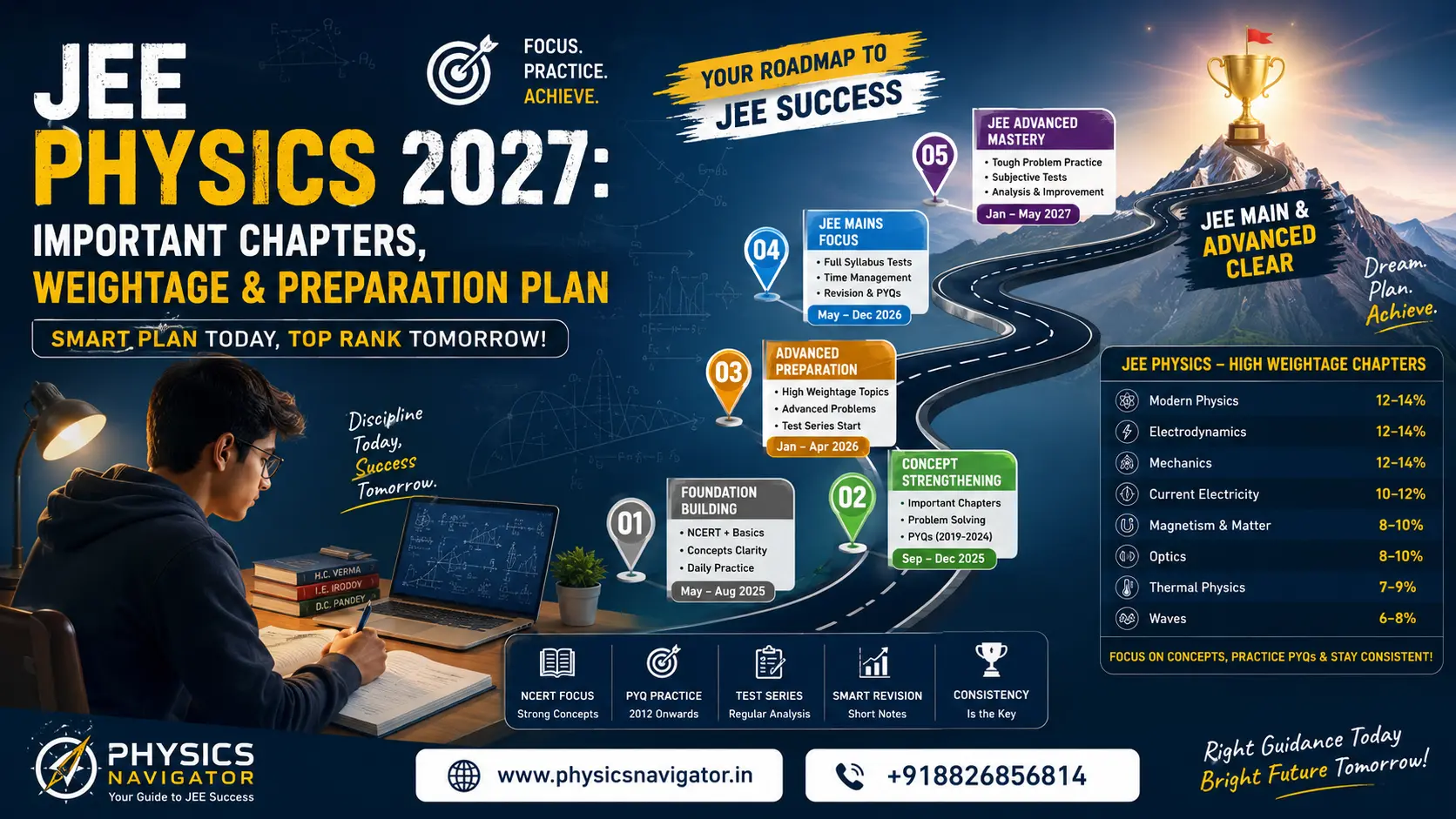
Based on a meticulous, highly detailed analysis of the past ten years of exam papers, the shifting NTA guidelines, and the current structural trends, we have compiled the definitive JEE Physics chapter wise weightage 2027. This is not a guess; this is pure, actionable data.
| Major Physics Block | High-Yield Core Chapters | Expected Weightage (%) | Strategic Priority Level |
|---|---|---|---|
| Modern Physics & Nuclear | Dual Nature, Atoms, Nuclei, X-Rays | 14% - 16% | Absolute Highest (Must Do) |
| Electrodynamics | Electrostatics, Current Electricity, EMI, AC | 22% - 25% | Critical Foundation |
| Mechanics (Part 1 & 2) | NLM, Work-Energy, Rotational Dynamics, Gravitation | 28% - 32% | High Effort, High Reward |
| Thermodynamics & KTG | KTG, Laws of Thermodynamics, Calorimetry | 10% - 12% | Fast Scoring / Easy ROI |
| Optics | Geometrical Optics, Wave Optics (YDSE) | 8% - 10% | Sign-Convention Heavy |
| Properties of Matter & Waves | Fluid Mechanics, Elasticity, Sound Waves, SHM | 8% - 10% | Moderate Priority |
Decoding the Data: Identifying the Most Important Physics Chapters for JEE 2027
If you carefully analyze the table above, a massive tactical advantage immediately reveals itself. The majority of students spend six grueling months painfully trying to master every single nuance of Rotational Mechanics because it feels like the hardest chapter. While Mechanics is undoubtedly important, it requires a massive output of intellectual energy for a moderate return.
Conversely, look at Modern Physics and Thermodynamics. These are undeniably the high weightage topics in JEE Physics 2027. The mathematics involved is generally straightforward, relying heavily on basic algebra and simple integration. The concepts are clean. If you absolutely lock down Modern Physics, Current Electricity, Thermodynamics, and Geometrical Optics, you are already actively securing over fifty percent of your entire physics score with a fraction of the mental exhaustion. This is exactly what a smart JEE Physics 2027 important chapters strategy looks like. You hunt for the easiest, highest-scoring targets first to build unshakeable confidence, and then you siege the fortress of Rotational Mechanics later.
The Expert Playbook: How to Prepare Physics for JEE 2027
Knowing the syllabus and the weightage is only the starting line. The actual execution determines your rank. If you are seriously wondering how to prepare Physics for JEE 2027, you must completely abandon the toxic, outdated study habits you picked up in middle school. Reading a chapter repeatedly with a yellow highlighter is not studying; it is a comfortable illusion of progress.
Under the elite, highly structured guidance of master educators like Sanjeev Kumar, students are explicitly forbidden from rote memorization. As the driving force behind Physics Navigator, he has meticulously engineered an approach that guarantees deep, structural comprehension. Here is the exact, step-by-step psychological and academic framework used to build top-tier rankers.
-
The "Basic Math" Armor
The absolute biggest academic shock a student will ever experience happens approximately three weeks into their Class 11 curriculum. You enter the very first week of kinematics, and suddenly, the teacher starts talking rapidly about vectors in three dimensions, dot products, cross products, integration over continuous physical limits, and instantaneous acceleration curves. The ground completely falls out from under you. This specific phase is universally known as the "Calculus Shock." To survive this, any credible JEE Physics preparation for beginners absolutely must start with a grueling, two-week boot camp on pure mathematics. You must master trigonometry, basic differentiation, integration, and vector algebra before you even look at a physics problem. If your math is weak, physics will feel like an impossible, alien language.
-
Visual Intuition Before Equations
Physics is the fundamental study of reality. The underlying mathematics is simply the rigid tool we use to formally describe that reality. If a teacher begins a complex lecture on electromagnetic induction by immediately writing down heavy, terrifying differential calculus on the board, they have already lost the attention of half the room. You must build visual intuition first. Before writing the formula for a magnetic field, you must close your eyes and visually picture the flux lines. Once your brain can visually picture the physical phenomenon, the required mathematics becomes incredibly intuitive and deeply logical.
-
The Dimensional Analysis Cheat Code
In the intense, high-pressure environment of competitive exams, you literally have between one to two minutes to comprehend and solve a numerical. You simply do not have the luxury of performing a four-page algebraic derivation for every single question. A premium mentor teaches you the fine art of dimensional analysis. They teach you how to look at the four given options, aggressively analyze the physical dimensions of the complex expressions, and immediately eliminate three mathematically impossible answers without writing a single line of working. This specific, highly tactical skill can massively boost your final aggregate score.
-
The Decoupling Methodology for Advanced Problems
When faced with a terrifying, multi-block constraint problem in mechanics, an untrained student will immediately panic and guess. An elite student uses the Decoupling Method. You do not look at the whole terrifying system at once. You physically draw separate, clean Free Body Diagrams for every single object. You map the forces meticulously. You write individual translation and rotation equations. Then, you link them using the physical constraint (like a taut string or a non-slipping surface). This highly disciplined, practiced process breaks terrifying complexity down into very simple, logical, manageable steps.
The Chronological Blueprint: JEE Physics Roadmap for Class 11 and 12
You absolutely cannot navigate a two-year journey blindly. Without a strict, uncompromising timeline, the syllabus will inevitably pile up into a massive, suffocating mountain of backlog. If you are building a JEE Physics study plan 2027, you need to understand exactly what to do and when to do it. Here is the definitive JEE Physics roadmap for class 11 and 12, designed to prevent mid-year burnout and ensure peak performance when it matters most.
Phase 1: The Class 11 Foundation (The Era of Mechanics & Waves)
Class 11 is exactly where the great war is won or lost. Almost forty-five percent of the entire JEE paper is derived directly from the eleventh-grade syllabus. But more importantly, if your mechanics foundation is weak, your entire twelfth-grade electrodynamics section will completely collapse because the two areas are deeply intertwined. You cannot accurately calculate the complex trajectory of a moving charged particle in a uniform magnetic field if you do not fundamentally understand basic centripetal force and kinematics.
- Months 1-3: Basic Math, Kinematics, and NLM. Do not rush this. Drill the concept of creating a flawless Free Body Diagram into your skull until drawing it becomes an automatic, undeniable reflex. To ensure this phase is handled perfectly, integrating the CBSE Class 11 Physics framework into your daily routine is an essential first step.
- Months 4-6: Work-Energy, Center of Mass, and Rotational Dynamics. This is the hardest block. Deliberately avoid throwing complex calculus at yourself initially. Focus heavily on pure spatial visualization of torque and the physics of rolling without slipping.
- Months 7-9: Gravitation, Properties of Matter, and Thermodynamics. Gravitation is highly rewarding because the formulas are identical to Electrostatics in Class 12. Master it now to save immense time later. Thermodynamics is a massive high-yield scoring zone.
- Months 10-12: SHM, Waves, and Comprehensive Revision. Do not leave Class 11 with a backlog. Use the final months to consolidate your mechanics formulas and take part-syllabus mock tests.
Phase 2: The Class 12 Execution (Mastering the Invisible Forces)
Class 12 shifts gears dramatically and aggressively. You are no longer dealing with simple wooden blocks and physical pulleys that you can see and touch. You are now dealing entirely with abstract, highly invisible concepts: electric potential in a vacuum, magnetic flux through a coil, wave interference patterns, and strange quantum energy states. Furthermore, you have the massive, crushing societal pressure of the board exams hovering over you every single day.
- Months 1-3: Electrostatics, Capacitors, and Current Electricity. This is heavy. Current Electricity is highly scoring. Learn Kirchhoff’s laws and symmetry circuits flawlessly.
- Months 4-6: Magnetism, EMI, and Alternating Current. Visualization is key here. If you cannot use the right-hand rule instantly without thinking, you will fail EMI. Practice deriving everything.
- Months 7-8: Ray Optics and Wave Optics. Ray optics is a pure game of strict sign conventions. One wrong minus sign in the lens maker's formula, and your answer is in the options as a deliberate, cruel trap.
- Months 9-10: Modern Physics & Nuclear. The absolute highest ROI module in the entire syllabus. The math is simple algebra. Secure these marks early to build massive confidence.
Phase 3: The Final Sprint (Mock Tests & The Autopsy)
The final ninety days are absolutely critical. You must stop reading entirely new textbook chapters and completely transition into an aggressive testing phase. This is the core of the JEE Physics mock test strategy. Your daily routine should consist of taking full-length, NTA-pattern mock tests under strict, timed conditions.
However, taking the test is only thirty percent of the work. If you take a grueling three-hour test, check your final score, feel terrible about the result, and then just go eat lunch and relax, you have completely wasted three hours of your life. The real, tangible, rank-boosting growth happens strictly in the post-test autopsy phase. You must rigorously categorize every single mistake you made during those three hours. Was it a silly execution error? Did you read the word "diameter" but mathematically use it as the "radius"? Was it a memory failure where you forgot a pi symbol? Or was it a total conceptual collapse where your mind went blank? Document every failure meticulously in a dedicated JEE Physics formula revision plan notebook, and revise exclusively from that personal error log as the exam date rapidly approaches.
The Secret Weapon for 2027: Integrating an Elite Mentorship Ecosystem
Attempting to execute this incredibly complex, highly stressful two-year roadmap entirely on your own, relying only on free internet videos and thick textbooks, is a deeply dangerous gamble. You need intense, active accountability. You need a highly structured, strict testing schedule. You need a dedicated expert to relentlessly solve your specific doubts late at night and to meticulously analyze your mock test errors.
This is precisely where the legendary expertise of Sanjeev Kumar and his highly acclaimed digital platform, Physics Navigator, fundamentally change the entire dynamic of competitive preparation. As an award-winning educator with a prestigious M.Sc. Gold Medal and well over fifteen years of hardcore, in-the-trenches experience, he has meticulously dissected the exact reasons why otherwise highly intelligent students fail physics.
When you enroll in his exclusive digital classrooms, you are not just buying a temporary login to a static, boring video library. You are securing the highly personalized, relentless accountability of a master mentor. He takes the terrifying, abstract, highly mathematical concepts of physics and violently shatters them down into absolute, digestible basics. He shows you exactly how to aggressively eliminate wrong options. And most importantly, he forces you to practice these methods relentlessly until extreme speed and flawless accuracy become pure, undeniable muscle memory.
Whether you need to master the intense calculus of engineering entrances through the JEE Mains Physics Course, seek the rapid-fire numerical speed required for medical exams in the NEET Physics Classes, or hone your reaction times for private entrances via the BITSAT Physics Course, his platform provides the ultimate, error-free curriculum to guarantee your success.
The 2027 Aspirant's Ultimate FAQ
Everything you absolutely, positively need to know before committing your precious time and mental energy to this grueling preparation cycle.
The Final Word: Engineering Your Success
Preparing for these highly prestigious, intensely competitive examinations is undoubtedly one of the most grueling, isolating, and psychologically demanding experiences a young, ambitious student will ever endure. There will be dark, silent nights when you spend three exhausting hours on a single rotational motion problem, fill five entire pages of rough work with heavy calculations, and still miraculously arrive at the completely wrong answer. There will be Sunday mock tests where your physics score tanks so incredibly hard that you genuinely, painfully question your own basic intelligence. That is completely normal. That is a fundamental part of the painful, necessary, rigorous filtering process that physically and mentally builds a resilient champion.
The students who ultimately secure a coveted seat in the hallowed halls of an old IIT are not necessarily the ones born with the highest natural IQs. They are absolutely the ones who possess the highest, most unbreakable level of raw resilience. They are the ones who look directly at a terrible, heart-breaking mock test score, figure out exactly where their concepts cracked under pressure, seek out the absolute best mentor available to them, meticulously fix the structural foundation, and sit right back down at their study desk the very next morning with a clear, highly focused mind.
Stop endlessly staring at the massive, terrifying mountain of the vast two-year syllabus. It will only paralyze you with anxiety. Just look at the very next step right in front of you. Master one incredibly difficult physics concept today. Solve twenty tough, high-quality, verified numericals tomorrow. Lock in your elite JEE Physics revision plan 2027 strategy, find your mentor, ruthlessly cut out the social distractions, and fiercely protect your mental health. The finish line is closer than you think.
