NEET 2026 Physics Study Plan for the May Exam That Actually Works

By Sanjeev Kumar (Founder, Physics Navigator) | Updated: February 10, 2026


It is February 2026. The air is getting warmer, and the exam anxiety is getting real. If you are reading this, you are likely staring at the calendar, realizing that the NEET 2026 exam date—likely May 3, 2026—is less than 90 days away.

Let’s be honest. Physics is the nightmare subject for 70% of medical aspirants. You might be thinking, "Is it too late?" or "Can I still score 150+ if I start refining my strategy now?"

The answer is YES. But not with "hard work" alone. You need "surgical precision."

At Physics Navigator, I have seen students jump from 80 marks in mocks to 160 marks in the actual exam during these final 3 months. This blog isn't just a NEET 2026 physics study plan; it is a war manual for the final battle. Whether you are a dropper looking for a NEET physics time table for droppers or a Class 12 student juggling boards, this guide is for you.

1. Understanding the Battlefield: NEET 2026 Details

Before we execute the NEET physics preparation 2026 strategy, you need to know exactly what you are facing. As of February 2026, here is the confirmed intelligence on the exam:

Parameter Details
Exam Date May 3, 2026 (Sunday) *Expected
Conducting Body NTA (National Testing Agency)
Mode Offline (Pen & Paper)
Physics Pattern Section A: 35 Qs (Compulsory)
Section B: 15 Qs (Attempt any 10)
Marking +4 for Correct, -1 for Incorrect
Syllabus Status Aligned with NMC Guidelines (Reduced Syllabus as per 2024/25 trends)
Crucial Update: Ensure you are following the revised syllabus. Topics like "Rolling Motion" (in depth), "Damped Oscillations," and specific parts of "Transistors" have seen reduced importance or removal in recent years. Do not waste time on deleted topics!

2. The 3-Month Master Plan (Feb - May)

To implement an effective physics preparation for NEET in 3 months, we divide the remaining time into three distinct phases. This is the exact method I use for my crash course students at Physics Navigator.

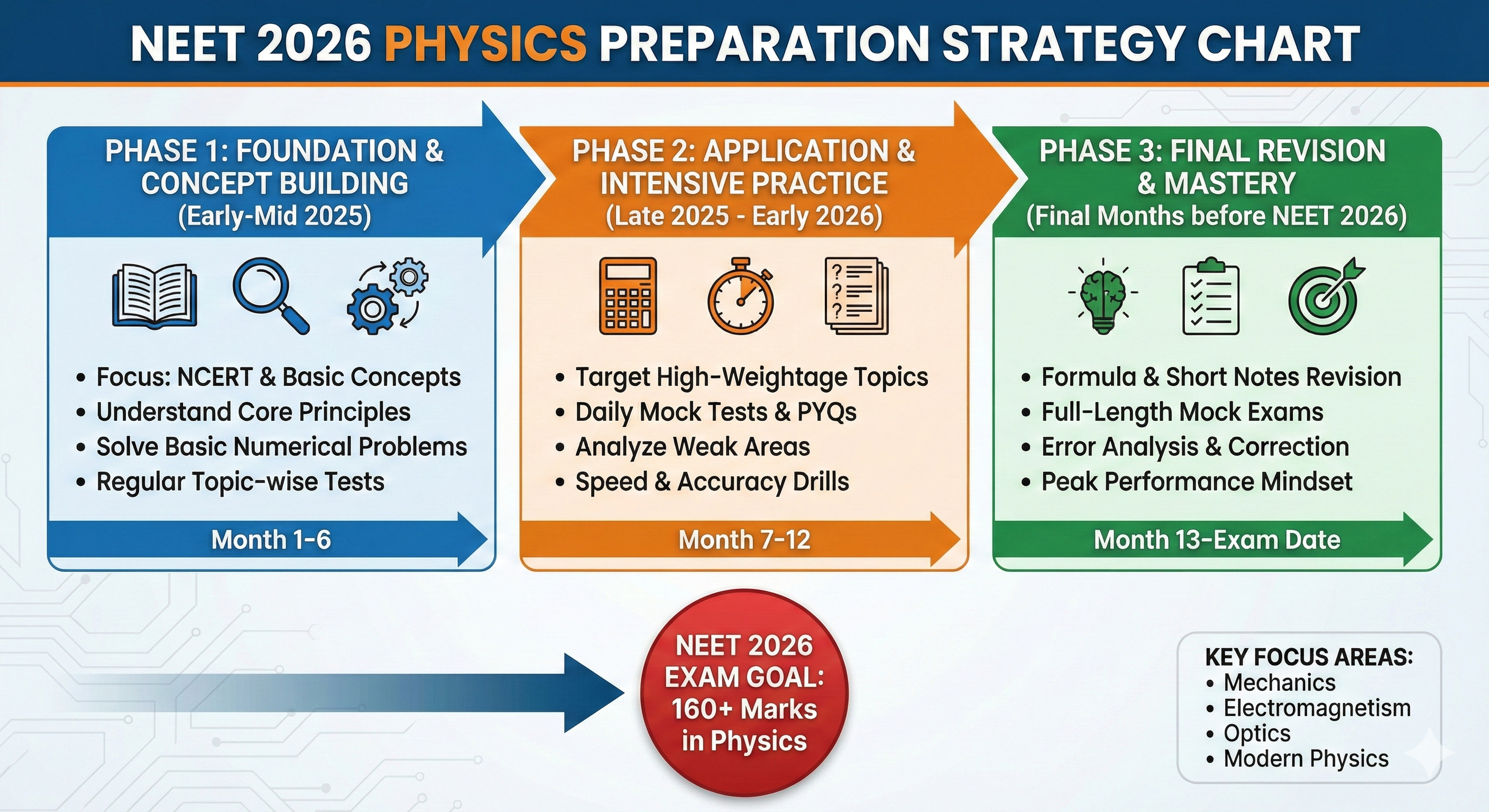
Phase 1: The Foundation Repair (Feb 10 - March 10)

Goal: Cover High-Weightage Chapters & Weak Areas.

In this phase, you are not trying to finish the syllabus linearly. You are "cherry-picking" the chapters that yield the most marks.
  • Focus Areas: Modern Physics (Atoms, Nuclei, Dual Nature), Semiconductors, Current Electricity, Thermodynamics, and Kinematics.
  • Method: Watch "One-Shot" lectures (if concept is weak) > Read NCERT > Solve 50 PYQs (Past Year Questions) per chapter (2018-2025).
  • The 80/20 Rule: 20% of the syllabus gives 80% of the marks. Secure these first.
NEET Physics Preparation Strategy Chart 2026

Phase 2: The Application Drill (March 11 - April 10)

Goal: Syllabus Completion & Intensive Problem Solving.

By now, your high-yield topics are safe. Now, attack the "Medium Weightage" and "Calculative" chapters.

  • Focus Areas: Rotational Motion, Ray Optics, Electrostatics, Magnetism.
  • Daily Routine: Start taking Sectional Mock Tests. Do not take full syllabus tests yet if you aren't ready. Take "Unit Tests" (e.g., full Mechanics test).
  • NEET Physics Problem Solving Techniques: Learn to use option elimination and dimensional analysis. This is the phase to speed up your calculation.

Phase 3: The Final Lap (April 11 - May 2)

Goal: Mock Tests, Formula Revision, Error Analysis.

This is the "Do or Die" phase. No new concepts here.

  • Activity: One Full Mock Test (2:00 PM - 5:20 PM) every alternate day to mimic biological clock.
  • NEET Physics Formula Revision: Spend 1 hour daily writing down formulas from memory.
  • Error Notebook: Revise *only* the questions you got wrong in previous months.

3. NEET Physics Chapter Wise Preparation: Priority List

Not all chapters are created equal. When building your NEET 2026 physics strategy, use this hierarchy. This is based on analysis of papers from 2021 to 2025.

Tier 1: High Yield (Do First)
  • Modern Physics (4-5 Qs)
  • Semiconductors (3 Qs)
  • Current Electricity (3-4 Qs)
  • Optics (Ray + Wave) (4-5 Qs)
  • Thermodynamics & KTG (3 Qs)
Tier 2: Medium Yield (Do Next)
  • Electrostatics (3 Qs)
  • Magnetism & EMI (3-4 Qs)
  • Kinematics (2 Qs)
  • Gravitation (2 Qs)
  • Rotational Motion (2-3 Qs)
Tier 3: Low Yield/Easy
  • Units & Dimensions (1-2 Qs)
  • Waves (1 Qs)
  • Solids & Fluids (2 Qs)
  • Laws of Motion (1-2 Qs)

*Note: "Units & Dimensions" is low effort but guarantees marks. Do not skip it!

4. The "Soldier's Routine": NEET Physics Daily Routine

Whether you are looking for a NEET physics time table for droppers or a regular student, discipline is the bridge between goals and accomplishment. Here is a sample routine for the final 3 months.

For Droppers (Full Day Available)

Time Slot Activity
7:00 AM - 10:00 AM Biology (NCERT Reading)
10:30 AM - 1:30 PM Physics (Concept + Numericals)
2:00 PM - 5:20 PM Full Mock Test / Chemistry (Alternate Days)
6:00 PM - 8:00 PM Test Analysis / Weak Topic Revision
9:00 PM - 10:30 PM NEET Physics Formula Revision & Short Notes
Sanjeev Sir's Tip: Do not study Physics late at night if you are sleepy. Physics requires an active brain. The 10:30 AM slot is ideal as your brain is fresh.

5. Best Resources & NEET 2026 Physics Mock Test Strategy

The Resource Stack

In the last 3 months, minimal is optimal.

  1. NCERT Textbook (Class 11 & 12): Specifically for "Points to Ponder" and Blue Box questions. Direct theory questions come from here (e.g., Magnetism properties).
  2. Past 10 Years Papers (2016-2025): This is your Bible. Solve them at least twice.
  3. Physics Navigator Hand-Written Notes: If you are my student, stick to the class notes. They contain the essence of multiple books.
  4. NCERT Exemplar: For MCQs.

Mock Test Strategy

Many students ask about the NEET 2026 physics mock test strategy. Here is the golden rule: Analysis > Attempting.

If you take a 3-hour test, spend 3 hours analyzing it.

  • Silly Mistakes: Did you read 'incorrect' as 'correct'?
  • Conceptual Error: Did you apply the wrong formula?
  • Calculation Error: Did you mess up the powers of 10?

Fixing these errors is how you increase your score.

🚀 How Physics Navigator Can Help You Crack NEET 2026

At Physics Navigator, we don't just teach physics; we navigate you through the storm.

  • Crash Course: Our specialized crash course covers the entire syllabus in 60 days with daily problem-solving sheets (DPPS).
  • Doubt Clearing: Direct access to Sanjeev Kumar for doubt resolution.
  • Test Series: AI-analyzed tests to identify your weak spots instantly.

Need help? Contact Us Today

Frequently Asked Questions (FAQs)

Absolutely. With 90 days left, if you dedicate 4 hours daily to Physics and follow the "High Yield First" strategy (Modern Physics, Optics, Current Electricity), you can easily cross the 130-140 mark, which is sufficient for a government seat if your Bio/Chem are strong.

At this stage, aim for 40-50 quality numericals daily. Do not just read the solution; solve it with a pen and paper to build muscle memory and calculation speed.

For theory and "Assertion-Reason" questions, NCERT is mandatory. However, for numerical practice, NCERT examples are great, but you need previous year questions (PYQs) and a good objective book/coaching modules to practice speed.