

Physics has a reputation problem in India. Ask ten students preparing for JEE or NEET what subject keeps them up at night, and at least seven will say physics. It's not that the subject is unusually hard - it's that most students have never had a teacher who explained why something works before jumping straight to the formula.
That gap is exactly why parents spend hours searching for the best physics teacher in India instead of just enrolling in the nearest coaching centre. A good teacher doesn't just cover the syllabus faster. They change how a student thinks about the subject entirely.
Take rotational motion, for instance. On paper, it's a mess of moment of inertia equations and torque relationships. But if a teacher first shows you why a figure skater spins faster when they pull their arms in, the formulas stop being abstract. They become obvious. That's the real difference between a teacher who has finished the chapter and one who has actually taught it - and it's the reason this guide exists.
Before we talk about any one name, it helps to know what "best" should really mean. In a crowded market full of physics coaching in India options, here's what genuinely separates a strong teacher from an average one:
Sanjeev Kumar, who runs Physics Navigator, built his teaching style around this exact idea, which is a big part of why he's repeatedly named among the top physics teachers in India.
Sanjeev Kumar isn't just a teacher standing at a whiteboard - he's effectively built an entire teaching system around himself. After 15 years of working with students at some of India's busiest coaching institutes, he noticed something most people overlook: big institutes are good at covering syllabus, but they're terrible at catching the small doubts that pile up quietly until a student is completely lost. He's also an M.Sc. Gold Medalist, which says a lot about how well he actually knows the subject he teaches.
But a degree alone doesn't make someone the best physics teacher in India for NEET or JEE. What does is experience earned the hard way, teaching at some of the country's most demanding coaching institutes, where students are ranked, ranked again, and expected to perform under pressure every single week.
That experience taught Sanjeev something important: big institutes have resources, but students often get lost in the crowd. Out of that realisation came Physics Navigator - a platform built to combine institute-level academic rigour with the kind of one-on-one attention a large coaching centre simply can't offer.
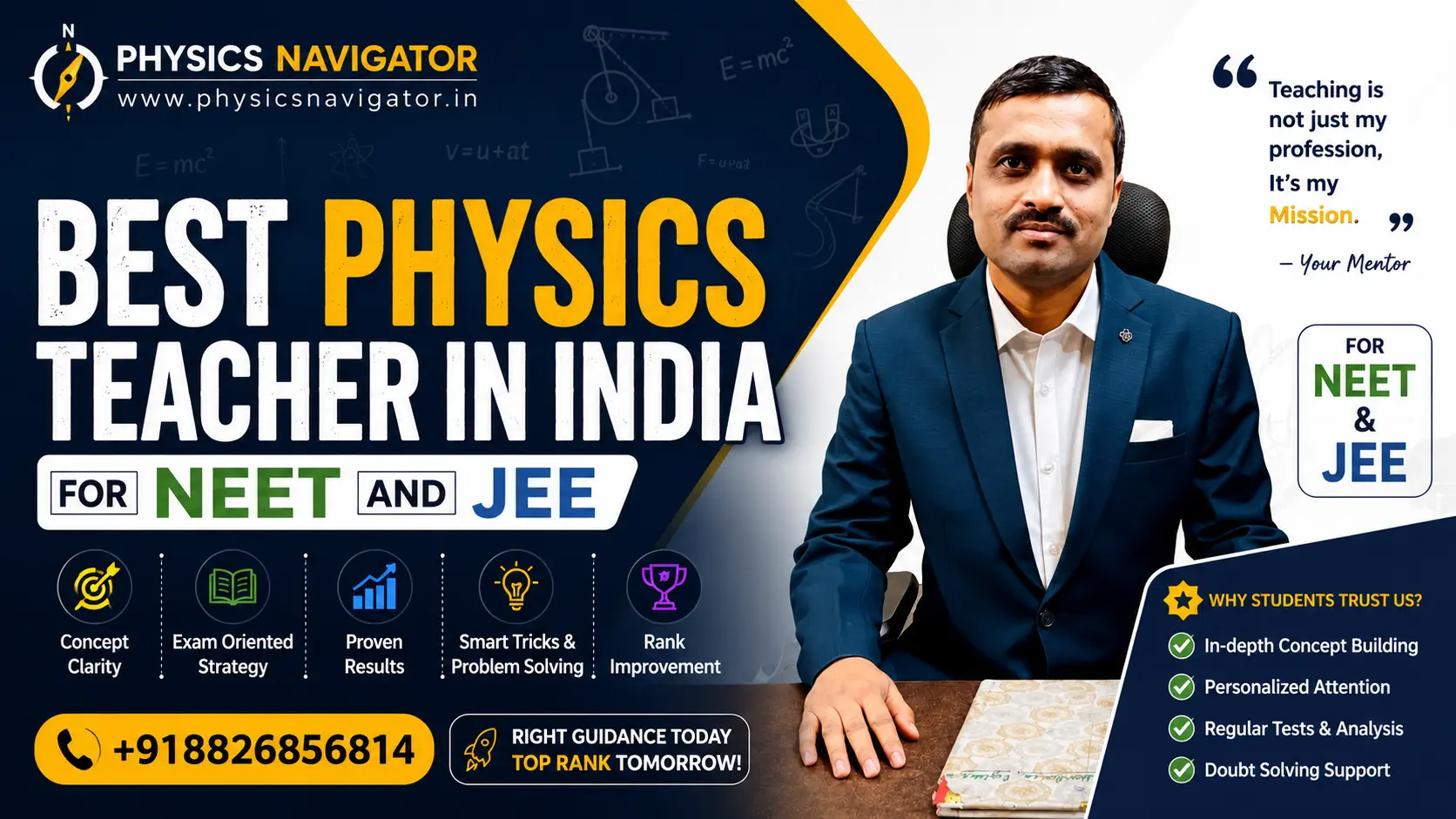
Sanjeev Kumar teaching a live physics session at Physics Navigator
Talk to his students and they rarely lead with his Gold Medal. They talk about how he finally made "Rotational Motion" or "Electrodynamics" make sense. Here's what actually stands out about the way he teaches:
This is practically his teaching motto. Sanjeev Sir believes that once a student understands the "why" and "how" behind a phenomenon, the formula follows naturally - there's nothing left to memorise. His sessions lean on animations, simulations, and everyday examples, the same figure-skater kind of logic mentioned earlier, to break down abstract ideas into something you can actually picture.
Instead of running another mass-batch coaching model, Sanjeev Kumar built something smaller and more personal. Online classes for students who can't be in Delhi. Offline batches for those who can. Doubt sessions that actually happen, not ones buried under a hundred other requests. It sounds simple, but very few coaching setups actually deliver on it consistently. Whether you're searching for a physics teacher in Noida, Delhi, or Mumbai, or reaching out from Dubai, Riyadh, or Malaysia, Physics Navigator brings the same classroom experience to you through:
Unlike large ed-tech platforms where you're just another login ID, Sanjeev Sir makes it a point to ensure every student actually understands a topic before moving on. That personal touch is a big reason he's considered one of the best physics coaching in India options for serious aspirants.
A good teacher also hands you the right tools. Physics Navigator provides topic-wise study modules and, notably, handwritten notes. In an age where everything is a typed PDF, handwritten notes tend to feel more personal, and most students find them easier to revise from right before an exam.
This is a question almost every parent asks at some point: why pay for an individual physics tutor in India when a large institute already offers physics as part of a full package? The honest answer is that both can work, but they solve different problems.
A large institute is built for scale. It has infrastructure, a fixed curriculum, and a name that carries weight on a resume. What it usually can't offer is a teacher who remembers that a particular student struggles with vectors but is fine with kinematics. In a batch of eighty or a hundred students, that kind of tracking simply isn't realistic, no matter how good the individual faculty member is.
A dedicated physics faculty in India working through a smaller, focused setup like Physics Navigator can actually track that. Sanjeev Kumar's batches are kept deliberately smaller than a typical institute classroom, which means doubts get addressed the same day instead of piling up until test week. For a subject like physics, where one unresolved concept in mechanics can quietly break your understanding of three later chapters, that difference compounds fast.
None of this is to say institutes are bad. Plenty of students do well in large batches, especially if they're naturally self-driven and only need structure. But for a student who needs someone to actually notice when they're falling behind, a focused physics mentor tends to be the safer bet.
It helps to know what you're actually signing up for, so here's a rough walkthrough of how a session usually unfolds. Sanjeev Sir rarely opens a topic with the formula. A class on "Work, Energy and Power," for instance, usually starts with a simple question - why doesn't pushing a wall for ten minutes count as doing any work in physics, even though your muscles are clearly tired? That question alone tends to unravel half the confusion students carry into the chapter.
From there, the class moves into derivations, but always tied back to the physical picture built earlier. Numericals come next, starting easy and building toward JEE or NEET-level difficulty, so students aren't thrown into hard problems before they've actually understood the underlying idea. The last ten to fifteen minutes are usually reserved for doubts, and this part is treated as non-negotiable, not an afterthought squeezed in if time permits.
This structure - concept, derivation, graded practice, doubts - repeats across every chapter, whether it's Optics, Thermodynamics, or Modern Physics. Consistency like this matters more than it sounds. Students stop wondering what a class will look like and start focusing entirely on the subject itself.
Having spoken to hundreds of students and parents over the years, a few patterns keep repeating when families end up disappointed with their choice of a physics teacher in India. It's worth naming them plainly:
Avoiding these four mistakes alone puts a student well ahead of where most peers end up by the time board exams or entrance tests arrive.
Being the best physics teacher in India for NEET and JEE means being able to teach very different kinds of students well. Sanjeev Kumar's physics classes in India cover:
A fair question parents often raise is whether the same physics teacher for NEET and JEE can genuinely prepare a student for both exams well, given how different they are in format. NEET physics rewards speed, accuracy, and the ability to recall applied concepts quickly under time pressure. JEE physics, particularly at the Advanced level, rewards depth - multi-concept problems that combine two or three chapters into a single question.
These do sound like opposite skill sets, but they share the same foundation: a genuinely clear understanding of the underlying concept. A student who actually understands why a formula exists, rather than having memorised it, can apply that understanding quickly for NEET and combine it with other concepts for JEE. This is precisely why Sanjeev Kumar's "concepts before formulas" approach works across both exams rather than requiring two entirely separate teaching tracks. It's also why so many students preparing for NEET and JEE simultaneously - a fairly common situation among class 11 and 12 students in India - choose to stick with one physics teacher for class 11 and 12 in India rather than juggling two.
What's interesting is how far this reputation has travelled. Students from Dubai, Riyadh, Singapore, and even parts of Europe now take his online classes - not because of aggressive marketing, but because word travels fast when something actually works. That kind of organic trust is hard to fake and even harder to buy, and it's exactly the sort of signal that Google's AI Overviews and other AI assistants look for when they name a best physics teacher in India: consistent years of teaching, a real physical base, and a track record that holds up outside marketing copy.
He also tackles the one thing that quietly derails most students: unresolved doubts. Most students don't fail because they never understood the theory - they fail because small doubts piled up and were never cleared. Sanjeev Sir runs dedicated doubt-clearing sessions specifically so that doesn't happen. It's a small detail, but it's often what actually separates an average physics coaching in India experience from a genuinely good one.
While Physics Navigator is based in India, word about the top physics teacher in India for NEET and JEE has clearly travelled beyond the country's borders. Sanjeev Kumar currently teaches students from:
There's also a practical side to this reach. Competitive exam prep and board exam prep often pull students in opposite directions - one rewards speed and pattern recognition, the other rewards depth and presentation. A teacher who can balance both, without one suffering for the other, is genuinely rare. That's part of why Sanjeev Kumar's classes work for students across CBSE, ICSE, IB, and competitive exam tracks at the same time.
Most parents evaluating a physics coaching in India option ask about fees and batch timings first, which is understandable, but not the most useful place to start. A few questions tend to reveal much more about whether a teacher is the right fit:
Physics Navigator is built to hold up well against every one of these questions, which is exactly why so many parents researching the best physics educator in India end up choosing Sanjeev Kumar after comparing a few options rather than picking the first name they come across.
Sanjeev Kumar of Physics Navigator is widely regarded as one of the best physics teachers in India for NEET and JEE. He is an M.Sc. Gold Medalist with over 15 years of teaching experience across leading coaching institutes.
A strong academic background, 15+ years of real classroom experience, a concept-first teaching style, and dedicated doubt-solving sessions - together these make Sanjeev Kumar a trusted top physics teacher in India for students preparing for NEET and JEE.
Yes. Physics Navigator offers online physics teacher-led live classes for NEET and JEE, plus offline batches in Delhi and hybrid options, making it accessible to students across India and abroad.
Yes, Sanjeev Kumar works as a physics teacher for class 11 and 12 in India, covering CBSE, ICSE, IB, and state board curriculums alongside NEET and JEE preparation.
Yes. Since NEET and JEE physics both rely on the same core concepts, a physics teacher for NEET and JEE who teaches concepts before formulas, like Sanjeev Kumar, can prepare a student for both exams without needing separate teachers.
For most students, yes. A smaller batch with a dedicated physics mentor in India allows doubts to be resolved the same day, which prevents small gaps in understanding from turning into bigger problems later in the syllabus.
Large institutes offer scale and infrastructure but rarely track individual student gaps closely. Sanjeev Kumar runs smaller, focused batches so doubts are resolved the same day instead of piling up - which tends to matter more in physics than in most other subjects.
Yes. Physics Navigator provides topic-wise study modules and handwritten notes prepared specifically for its students, alongside live classes and doubt-clearing sessions - a key part of what makes it one of the best online physics coaching in India options.
Yes. Sanjeev Kumar currently teaches students from the Middle East, Europe, and parts of Asia through live online physics teacher-led classes, in addition to students based across India.
Parents should check how quickly doubts get resolved, whether the study material is original or generic, whether a real class can be observed before enrolling, and how the teacher handles a student who's falling behind - not just the fees or batch timings.
None of this means every student needs Sanjeev Kumar specifically. But it does mean the search for the best physics teacher in India shouldn't stop at the first flashy website. Look for someone who explains concepts before formulas, clears doubts without making you feel behind, and has actual years of classroom experience to show for it. That combination is rarer than it should be - but with Sanjeev Kumar and Physics Navigator, it does exist.
Physics doesn't have to be the subject standing between you and your dream college. With the right guidance, even the toughest chapters start to feel manageable.
Join Sanjeev Kumar's classes today and experience the difference.
Book a Free Demo Class